
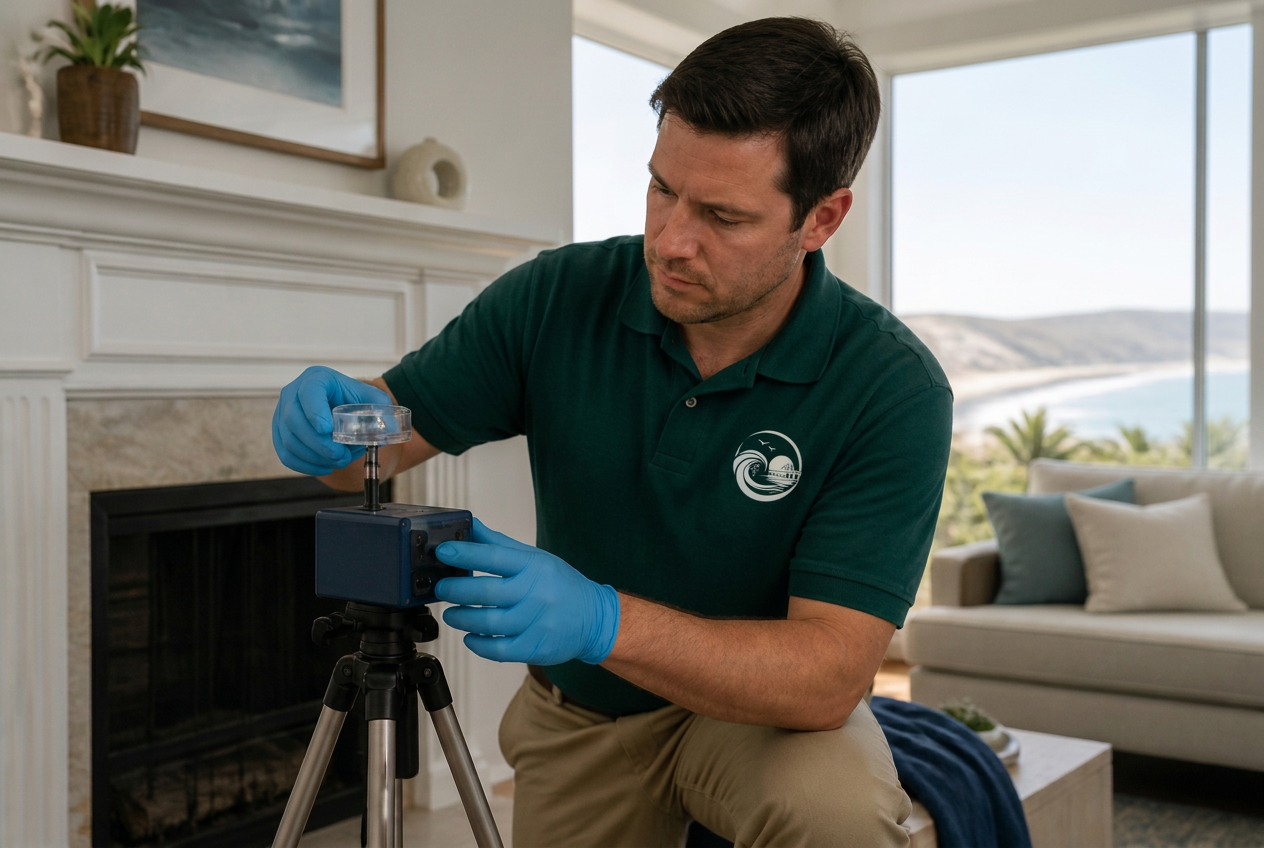
Air sampling measures what is actually airborne and available to breathe. A calibrated pump draws a known volume of air through a spore trap cassette; the particles impact onto a coated slide, and a laboratory analyst counts and identifies them under a microscope. The result is reported as spores per cubic meter by type.
The reason this works is comparison. Outdoor air in Manhattan Beach always contains mold spores — that is normal and expected. We collect an outdoor control on the same day, in the same weather, with the same equipment. When indoor counts of water-damage-associated types run well above that control, the pattern points to an indoor source.
How a proper air sample is collected
Protocol discipline is what separates a usable sample from an expensive guess. We follow published sampling practice on every job.
- Pumps are flow-calibrated before collection and the sampled volume is recorded
- Windows and exterior doors stay closed for a period before sampling so indoor air is representative
- Cassettes are held at breathing height, away from vents, fans and foot traffic
- An outdoor control is collected upwind of the building on the same visit
- Each cassette is sealed, labeled with room, time and volume, and logged under chain of custody
- Sampling locations are photographed and included in the report
Where we place samples
Typical residential work uses two to four indoor samples plus the outdoor control: the complaint room, a comparison room on the same level, and often a hallway or common area to represent general living space. Where a specific assembly is suspected, we may add a wall cavity sample, which draws from inside the wall through a small port rather than from the room.
More samples are not automatically better. We place them where the results will distinguish between two possible explanations, which is what makes the data useful.
What spore types tell us
Cladosporium and basidiospores are common in outdoor coastal air and often appear indoors at similar levels — that is usually background. Elevated Aspergillus/Penicillium indoors suggests an amplification source, frequently a damp cavity or chronically humid space. Stachybotrys and Chaetomium are associated with materials that have been wet for an extended time, and their presence in indoor air normally prompts an invasive look.
We interpret the profile against the control and against what we saw and measured during the inspection, rather than reading numbers in isolation.
Limitations we tell you about upfront
Air sampling is a snapshot of a few minutes in one location. Spore release is episodic — disturbance, HVAC cycling and door movement all change results. A single clean sample does not prove a building is free of hidden mold, and a single elevated sample does not by itself locate the source. That is why we never sell air sampling as a stand-alone product: it belongs inside an inspection that includes moisture mapping and a visual assessment.
Working with a local Manhattan Beach inspector
We are a service area business. Our inspectors travel to your property in Manhattan Beach rather than receiving visitors at an office, and we keep our work inside this one city so we know its housing stock, its weather patterns and its building department expectations. You can read more about our inspectors and standards, browse related work such as Mold Testing, Indoor Air Quality Testing and Post Remediation Verification, or contact us to schedule. Common questions are answered on our homepage FAQ.