
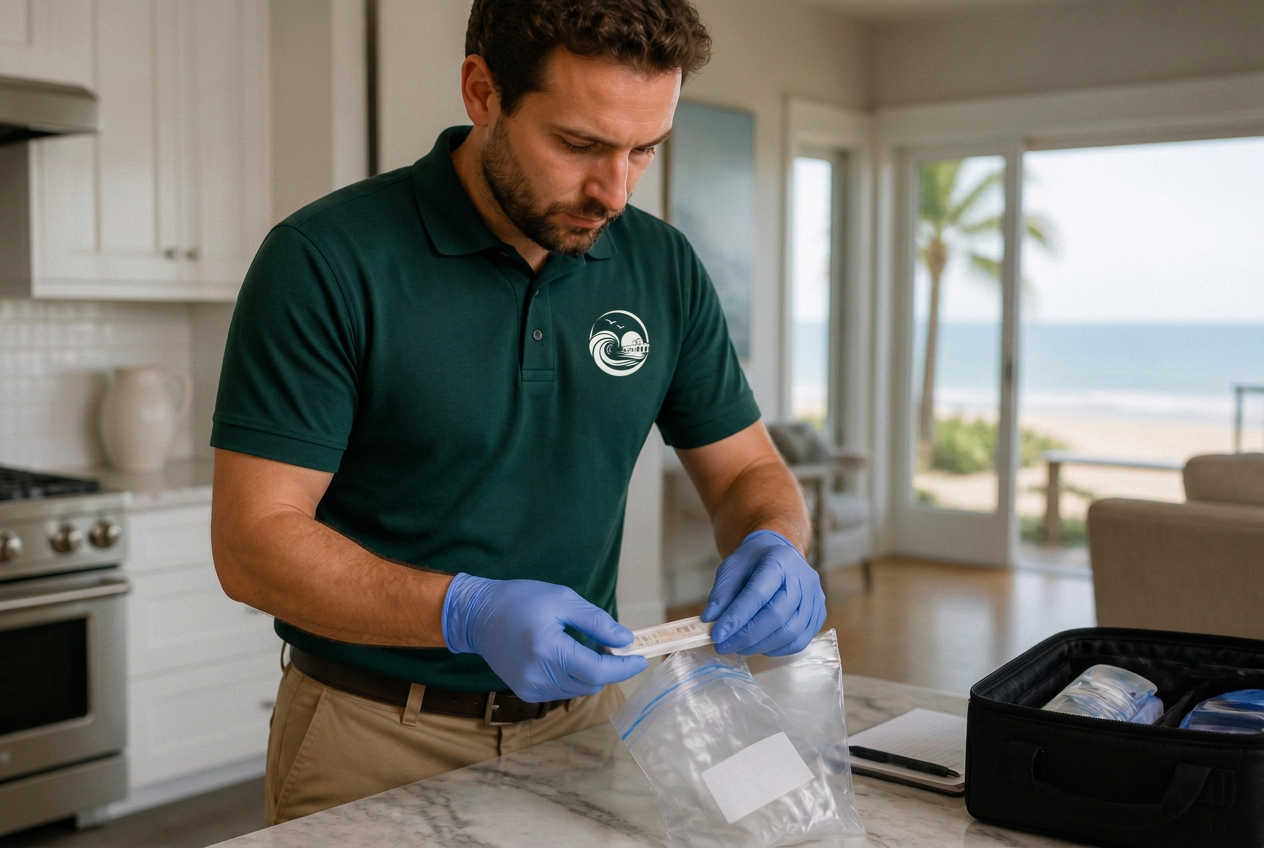
Mold testing answers questions that looking cannot. It tells you which spore types are present, whether indoor levels are elevated compared with outdoor air, and whether a suspicious patch of growth is actually mold or simply staining. In Manhattan Beach, where marine humidity keeps outdoor spore counts steady year-round, that outdoor comparison is essential — a number on its own means very little without the baseline to read it against.
We collect samples using published protocols, log chain of custody, and send them to an independent accredited laboratory. We do not analyze our own samples, and we do not sell removal work based on the results, so the numbers you get are simply the numbers.
Types of mold testing we perform
The right test depends on the question. We choose the sampling method with you before collecting anything, so you are never paying for data that will not change a decision.
- Air sampling with spore trap cassettes, including an outdoor control sample for comparison
- Surface sampling by tape lift to identify growth on a visible material
- Swab sampling for irregular or textured surfaces where a tape lift will not seat
- Wall cavity sampling, which draws air from inside an enclosed assembly through a small access point
- Post-remediation clearance sampling after another company has completed removal work
- HVAC-related sampling where distribution equipment is suspected of spreading spores
How laboratory analysis works
Once collected, each sample is sealed, labeled and logged under chain of custody, then delivered to an accredited environmental laboratory. Spore trap cassettes are analyzed by direct microscopy: an analyst counts and identifies spore types, reporting results in spores per cubic meter of air. Surface samples are examined for the presence of fungal structures and reported by relative abundance.
Standard turnaround is typically two to three business days, with expedited options when a transaction or a family health concern is on the clock. We forward the laboratory's original report along with our interpretation — you always get the raw data, not just our summary of it.
Reading your results without guesswork
California has no legal exposure limit for indoor mold, so no laboratory can tell you a result is "safe" or "unsafe." What results can show is whether the indoor spore profile looks like the outdoor profile. When indoor levels of a water-damage-associated genus such as Stachybotrys, Chaetomium or Aspergillus/Penicillium sit well above outdoors, that pattern points to an indoor amplification source.
Our reports explain what was found in each location, how it compares to the control sample, what the pattern suggests about a hidden source, and what we would investigate next. If the results are unremarkable, we say so plainly rather than manufacturing concern.
When testing is worth the cost
Testing is most valuable when it will change something: a purchase decision, a landlord conversation, an insurance claim, a remediation scope, or a decision about whether a family member with asthma should stay in the home. It is least valuable when large visible growth has already been confirmed and the plan is clearly to remove it — in that case, moisture diagnosis and clearance testing afterward matter more than proving what is already obvious.
Chain of custody and defensible documentation
Documentation matters when a report ends up in front of an adjuster, an attorney or a buyer's agent. Every sample we collect is recorded with location, time, volume of air drawn, operator, and laboratory receipt. The report includes a photo of each sampling location. That level of record-keeping is why our reports hold up in real estate and rental disputes across Manhattan Beach.
Working with a local Manhattan Beach inspector
We are a service area business. Our inspectors travel to your property in Manhattan Beach rather than receiving visitors at an office, and we keep our work inside this one city so we know its housing stock, its weather patterns and its building department expectations. You can read more about our inspectors and standards, browse related work such as Air Sampling, Surface Sampling and Post Remediation Verification, or contact us to schedule. Common questions are answered on our homepage FAQ.