
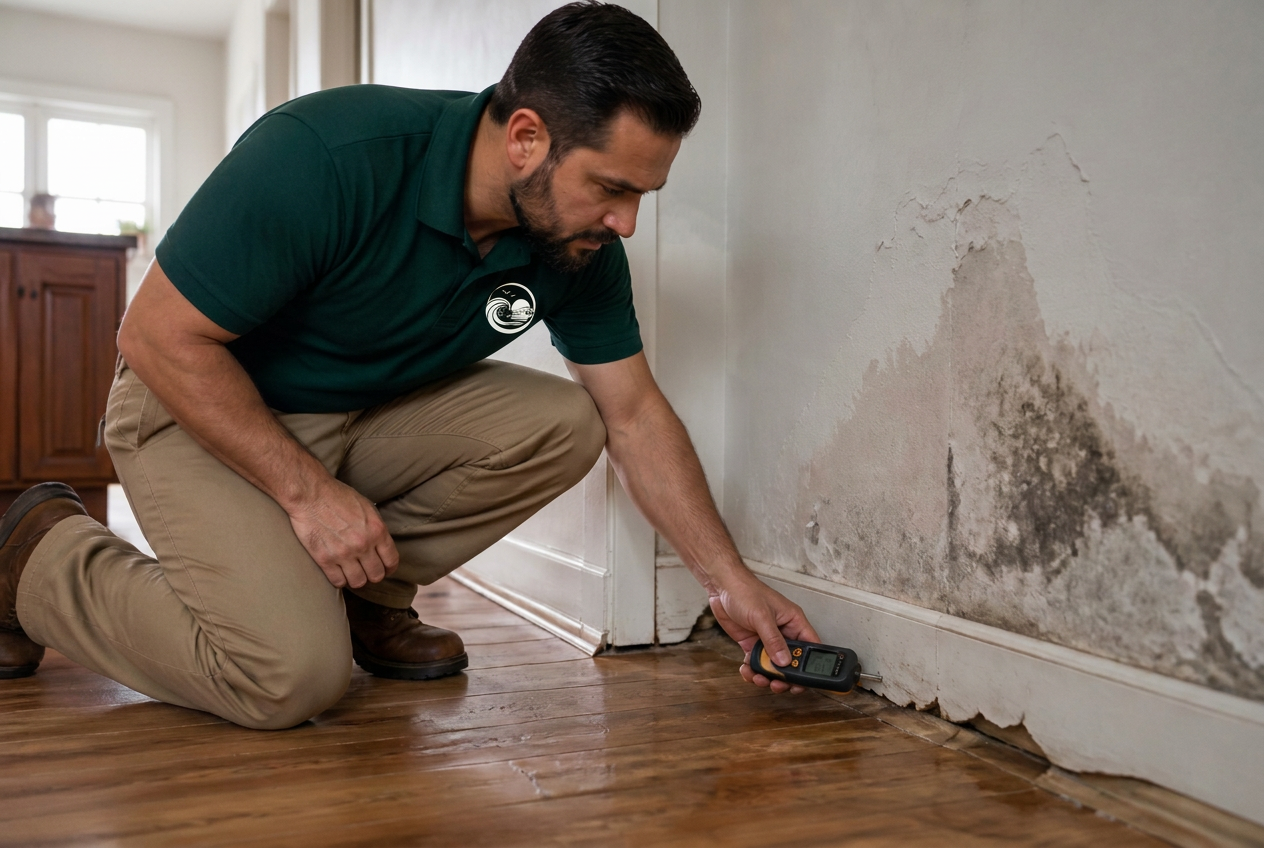
Water damage does not end when the water stops. Mold can begin developing on wet cellulose materials within roughly 24 to 48 hours, and the materials that stay wet longest — insulation, subfloor, framing behind cabinets, the underside of a shower pan — are the ones nobody sees. A property can look completely restored and still hold a damp cavity.
A post water damage inspection is the verification step. We measure what is still wet, document what the drying process reached and what it missed, and identify whether growth has already begun. It is the single most useful thing you can do between the mitigation crew leaving and the reconstruction crew arriving.
Common water events we inspect after
Whatever the source, the questions are the same: how far did the water travel, and is anything still wet?
- Supply line and angle stop failures under sinks, toilets and appliances
- Water heater tank ruptures and pan overflow
- Slab leaks and under-slab drain failures
- Roof leaks and storm intrusion during winter rain
- Shower pan and tile assembly leaks that were dripping for months before discovery
- Sewage backups and drain line overflows, which carry contamination as well as moisture
- HVAC condensate overflow into ceilings and closets
- Fire suppression discharge and firefighting water
Verifying that drying actually worked
Restoration crews do good work, but the drying record is usually theirs, and the equipment is placed based on what was accessible. We check independently: readings on framing, subfloor and cavity materials compared with dry reference points, thermal imaging across the affected zone and its perimeter, and humidity readings in enclosed spaces.
We frequently find residual moisture just past the boundary of where the equipment was set — behind a cabinet toe kick, inside an interior partition that wicked water, under flooring at a doorway threshold. Finding it before drywall goes back on saves a second demolition.
Documenting the loss for insurance
Adjusters respond to measured, dated evidence. Our reports include photographs, moisture readings with locations, thermal images, affected-area boundaries and laboratory results where sampling was performed. Because we are independent of both the restoration contractor and the carrier, the documentation is difficult to characterize as self-serving.
Timing matters
The best time to call is within the first few days after the event, before reconstruction begins. The second-best time is now, if reconstruction has already happened and the smell came back. Both are worth doing — but the earlier inspection costs far less than the one that follows re-opening finished walls.
If growth has already started
We document the extent, sample as needed to identify what is present, and describe a scope for remediation. You take that scope to removal contractors of your choosing. When the work is complete, we return for post remediation verification so there is independent confirmation before you rebuild.
Working with a local Manhattan Beach inspector
We are a service area business. Our inspectors travel to your property in Manhattan Beach rather than receiving visitors at an office, and we keep our work inside this one city so we know its housing stock, its weather patterns and its building department expectations. You can read more about our inspectors and standards, browse related work such as Moisture Detection, Post Remediation Verification and Mold Testing, or contact us to schedule. Common questions are answered on our homepage FAQ.