
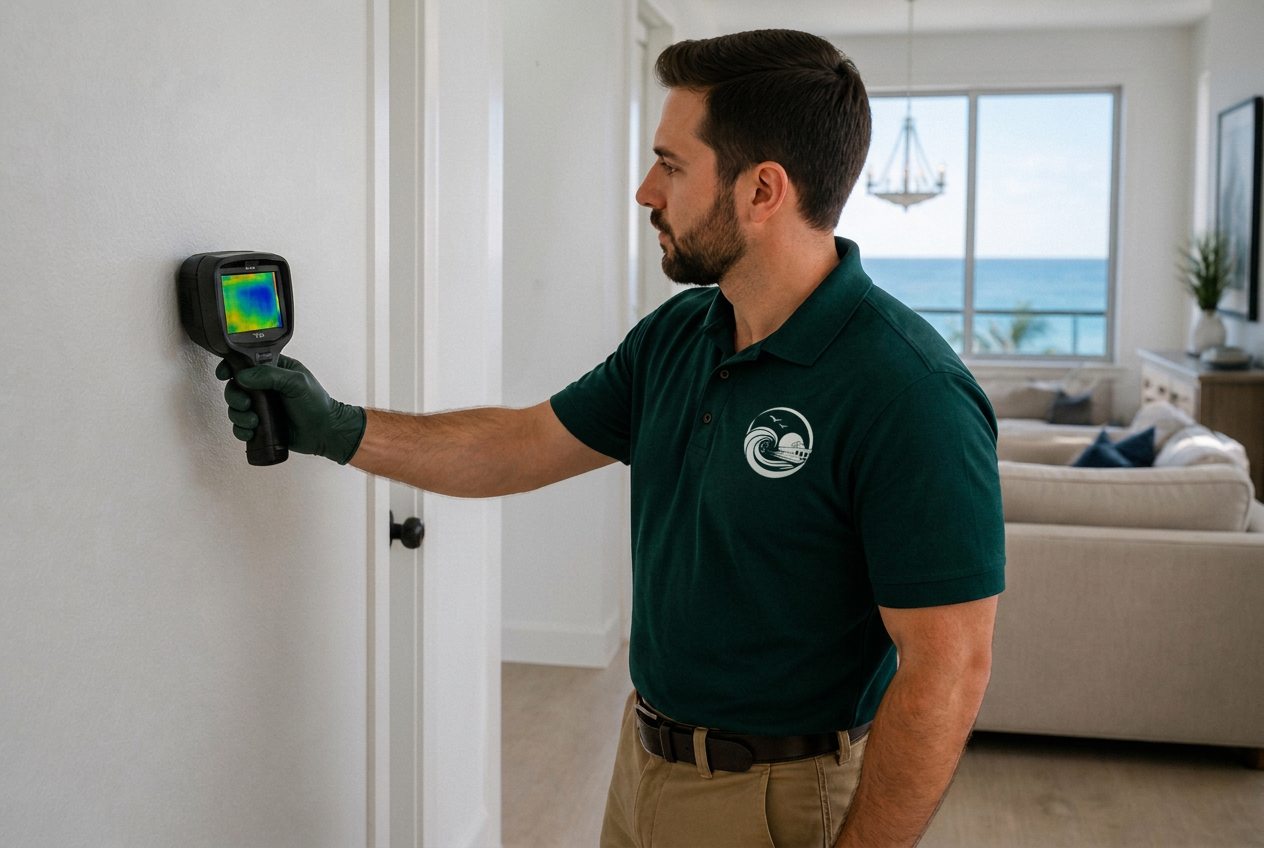
A mold inspection in Manhattan Beach starts with a simple question: where is the water coming from? Mold does not appear without moisture, and in a beach city where marine layer humidity sits over the neighborhood most mornings, that moisture is often slow and quiet rather than dramatic. A pinhole in a supply line behind a vanity, a shower pan that leaks a cup a week, condensation on the cold side of an exterior wall — those are the conditions that grow mold inside a wall long before anyone sees a stain.
Our inspectors walk the property with you, not around you. We look at the areas that matter in local housing stock: crawl spaces under older beach cottages, flat and low-slope roof transitions, second-story bathrooms stacked over living rooms, garages converted into offices, HVAC closets, window sills on the ocean-facing elevation, and the base of every exterior wall. Everything we find is photographed, measured and written into a report you can hand to a contractor, a landlord, an insurance adjuster or a buyer.
What a mold inspection actually includes
An inspection is an investigation, not a walkthrough. We combine what we can see with what instruments can measure, because the visible portion of a mold problem is usually the smallest part of it.
- A room-by-room visual assessment of walls, ceilings, floors, closets, cabinets and window assemblies
- Moisture meter readings on drywall, plaster, wood framing, subfloor and trim in every suspect area
- Thermal imaging to reveal temperature anomalies that suggest active moisture behind finishes
- Relative humidity, temperature and dew point readings that show whether the indoor environment supports mold growth
- Inspection of attics, crawl spaces, under-sink cabinets, laundry areas, water heater closets and HVAC equipment where accessible
- Photo documentation of every finding, keyed to the location where it was recorded
- A written report with findings, likely moisture sources and recommended next steps
Signs it is time to book an inspection
Most people call us for one of a handful of reasons, and all of them are legitimate. You do not need visible mold to justify an inspection — in fact, if you can already see it, the more useful question is how far it extends.
- A musty or earthy smell that comes and goes, especially after rain or on humid mornings
- A past leak, roof repair, slab leak or overflow that was dried without anyone verifying the wall cavity
- Staining, bubbling paint, warped baseboards or soft drywall near plumbing or exterior walls
- Allergy-type symptoms — congestion, itchy eyes, cough — that ease when you leave the property
- A real estate transaction where a general home inspector flagged moisture or recommended a specialist
- A rental dispute where an independent, documented opinion is needed
Why independent inspection matters
We do mold inspection and mold testing only. We do not sell mold remediation, we do not take referral fees from removal contractors, and we have no financial reason to find a bigger problem than the one that exists. That separation is the entire value of hiring an inspector: the person telling you how large the problem is should not be the person billing you to fix it.
It also matters for the other direction. Plenty of our inspections end with "your moisture readings are normal, the smell is coming from the drain trap, and you do not need remediation." That answer is worth just as much as finding a problem, and you can only trust it from a company with nothing to sell you afterward.
Our inspection process, step by step
Interview first. We ask about the history of the building, past leaks, remodels, how long symptoms have been present, and which rooms feel different. Owners almost always know more than they think they do.
Then a perimeter and interior walk with instruments in hand. We map moisture, take thermal images, and note construction details that make certain assemblies vulnerable. Where the history and the readings point to a hidden problem, we discuss sampling with you before collecting anything, so you know what each sample costs and what it will and will not prove.
Finally, the report. You receive photos, readings, laboratory results if samples were taken, an interpretation written for a homeowner rather than a scientist, and a recommended scope of work you can send to remediation contractors for competitive bids.
Local conditions in Manhattan Beach
Coastal properties here deal with salt air, persistent morning humidity, and a lot of homes built in eras with very different moisture-control expectations. Sand-set slabs, older stucco with tired weep screeds, additions built over patios, and tightly sealed remodels that trap humidity all show up regularly in our reports. Understanding that context is the difference between guessing and diagnosing, and it is why we work only in this city rather than spreading across the county.
Working with a local Manhattan Beach inspector
We are a service area business. Our inspectors travel to your property in Manhattan Beach rather than receiving visitors at an office, and we keep our work inside this one city so we know its housing stock, its weather patterns and its building department expectations. You can read more about our inspectors and standards, browse related work such as Mold Testing, Moisture Detection and Thermal Imaging, or contact us to schedule. Common questions are answered on our homepage FAQ.