
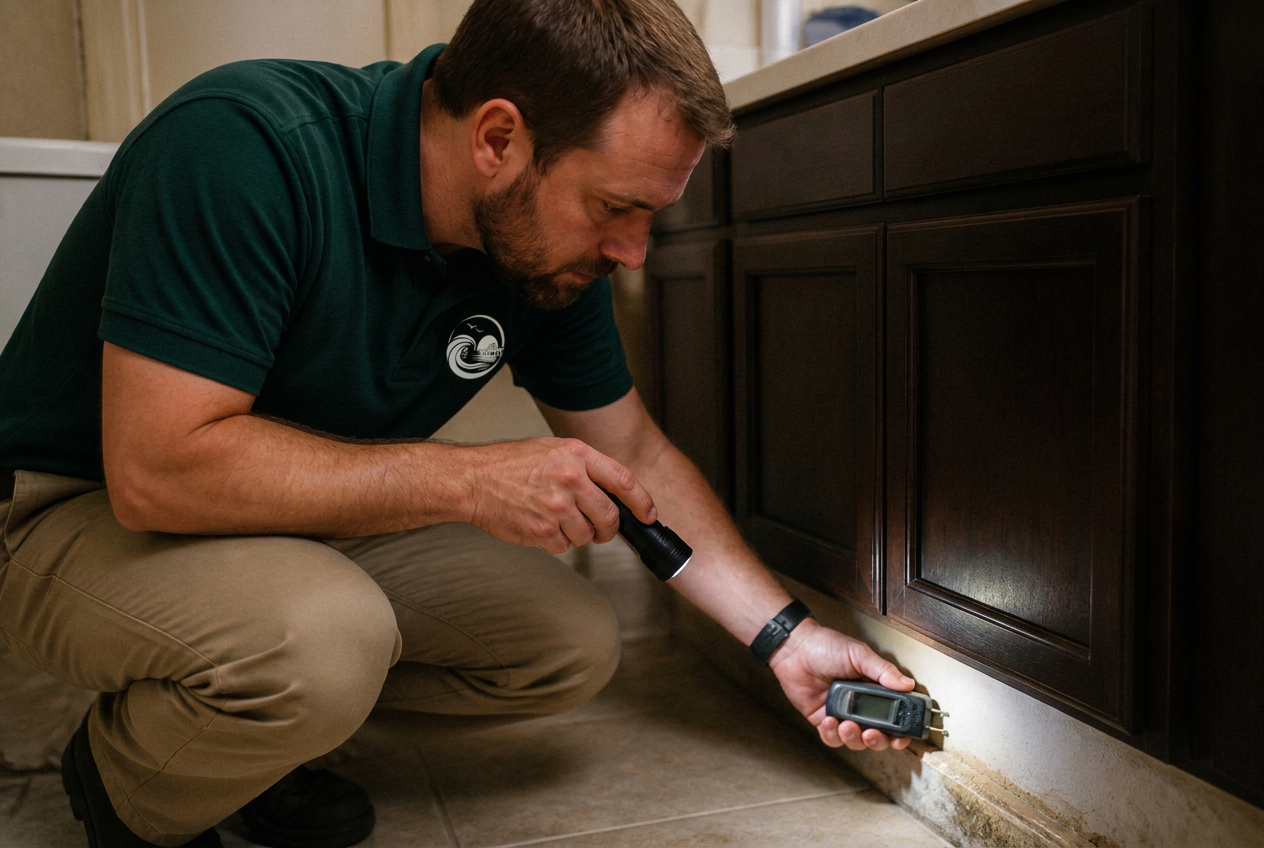
Every mold problem is a water problem wearing a disguise. Moisture detection is the part of our work that identifies where water is entering, how far it has traveled, and whether the material is still wet today. Without that, remediation is guesswork and mold returns within months.
We use several instruments together because no single tool is reliable on its own. Pinless meters scan large areas quickly without marking finishes. Pin meters confirm depth-specific readings in wood and drywall. Thermal imaging reveals evaporative cooling patterns that point to moisture behind a surface. Hygrometers establish whether the air itself is the source. Cross-checking those readings is what turns a suspicion into a documented finding.
Where hidden moisture usually hides
Local construction gives us a fairly predictable list of first places to look, refined by whatever the property's history suggests.
- Under and behind vanities, dishwashers, refrigerators with ice lines, and washing machines
- Shower pans, tiled curbs, and the wall directly opposite a second-floor bathroom
- Window and door assemblies, especially on the ocean-facing elevation where wind-driven rain hits hardest
- Roof-to-wall transitions, parapets, skylight curbs and low-slope sections
- Slab perimeters, sill plates and the base of stucco walls where weep screeds are buried or blocked
- Crawl spaces with poor vapor control, standing water or missing ground cover
- HVAC condensate pans, drain lines and supply plenums that sweat in humid weather
How we map a moisture problem
We start dry and work toward wet. Readings are taken across a grid so we can draw a boundary rather than record isolated points, then we compare readings in the suspect area with a known-dry reference of the same material elsewhere in the building. That comparison is what makes a number meaningful — twelve percent means one thing in framing lumber and another in gypsum board.
Every elevated reading is photographed with the meter in frame and its location noted. When the pattern suggests an active leak rather than a historical one, we look upstream: plumbing, roof, envelope, or condensation, in that order of frequency.
Active leak or old damage?
This distinction changes everything about the repair scope and the insurance conversation. Materials that dried months ago read close to reference values even when they are stained. Materials still being fed by a leak stay elevated and often show a rising gradient toward the source. We document which one you are dealing with and explain the reasoning, because "stained but dry" and "wet right now" call for very different responses.
Non-invasive first, invasive only with permission
We can complete most moisture mapping without damaging finishes. When readings and thermal patterns strongly indicate a wall cavity problem that we cannot confirm from outside, we discuss a small inspection port or cavity sample first, get your approval, and place the access where repair will be simplest. Nothing gets opened without your say-so.
What the report gives you
A moisture report includes annotated photographs, the readings with reference comparisons, thermal images where relevant, the suspected source, and a description of the affected area boundaries. Contractors can bid from it directly, and adjusters can see exactly what was measured and when.
Working with a local Manhattan Beach inspector
We are a service area business. Our inspectors travel to your property in Manhattan Beach rather than receiving visitors at an office, and we keep our work inside this one city so we know its housing stock, its weather patterns and its building department expectations. You can read more about our inspectors and standards, browse related work such as Thermal Imaging, Post Water Damage Mold Inspection and Mold Inspection, or contact us to schedule. Common questions are answered on our homepage FAQ.