
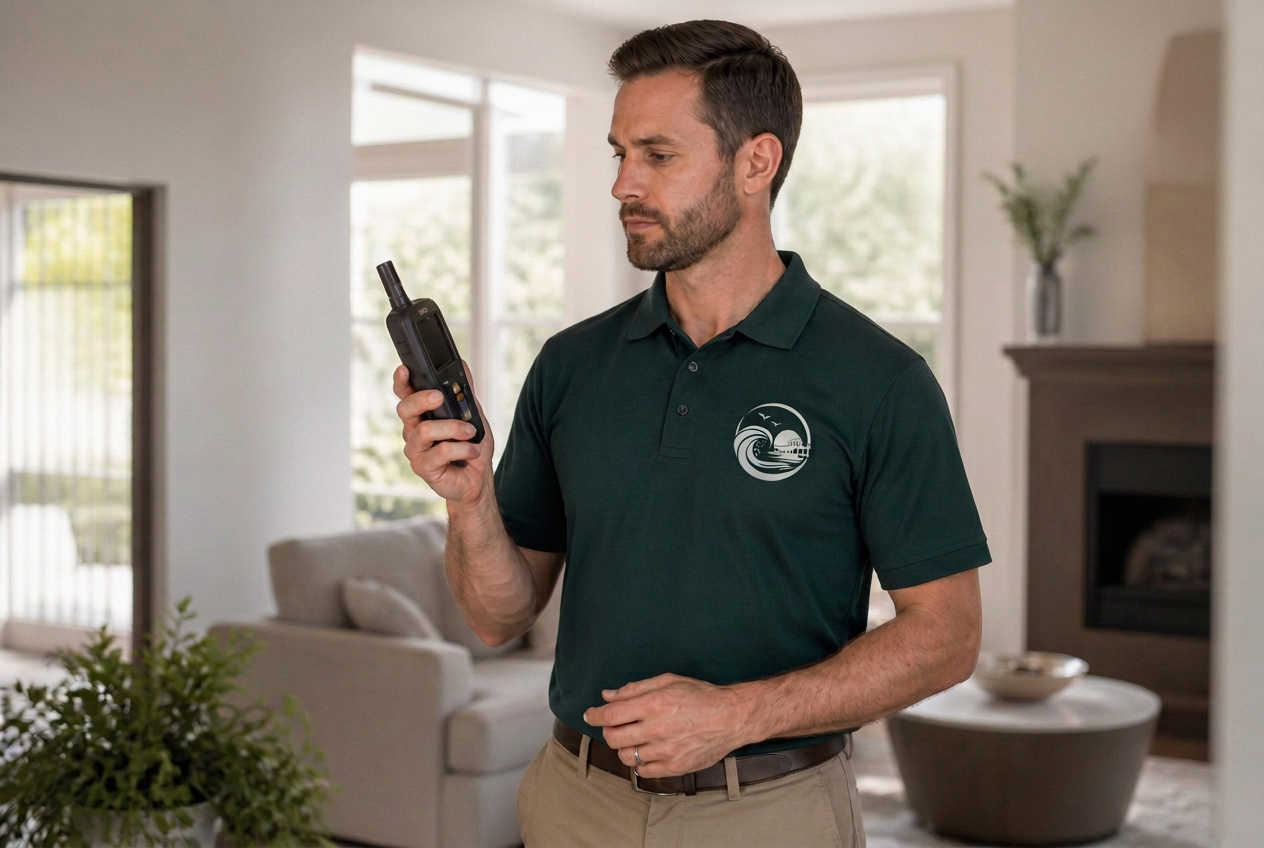
Indoor air quality testing goes a step beyond mold testing. It looks at the whole indoor environment — spore levels, relative humidity, temperature, ventilation behavior and airborne particulates — and connects those measurements to the way the building is operating. It is the right service when someone in the household feels better outside than inside and no single cause is obvious.
In Manhattan Beach, indoor air is shaped by a specific set of local factors: high outdoor humidity for much of the year, tightly remodeled envelopes that trap moisture, garage-adjacent living spaces, and HVAC systems that were sized for a milder load than the one they carry today. We measure rather than assume.
What we measure during an IAQ assessment
Every assessment is documented with instrument readings at multiple locations, so you can see how conditions vary between rooms rather than getting a single whole-house number.
- Airborne mold spore concentrations with paired indoor and outdoor control samples
- Relative humidity and temperature, plus calculated dew point for condensation risk
- Airborne particulate levels across fine and coarse fractions
- Carbon dioxide as an indicator of ventilation adequacy and air exchange
- Visual assessment of HVAC filtration, return leakage, duct condition and supply balance
- Moisture readings on building materials that could be feeding biological growth
Symptoms that point to an indoor air problem
Air quality complaints tend to follow a pattern. Symptoms improve within hours of leaving the property and return the same evening. They cluster in specific rooms. They worsen when the HVAC runs, or when windows have been shut for several days. When we hear that pattern, we know where to concentrate the measurements.
We are inspectors, not physicians, and we never diagnose health conditions. What we can do is give a clinician or an attorney a clear, dated dataset describing the environment a person is living in.
Humidity is the lever most homes can actually pull
Below roughly 50 percent relative humidity, most mold species cannot sustain active growth on ordinary building materials. Above 60 percent, growth becomes likely wherever dust and cellulose are present. Many Manhattan Beach homes sit between those two numbers for months at a time, especially in bedrooms with closed doors and bathrooms with undersized exhaust fans.
Our reports identify the rooms where humidity or dew point conditions favor growth and describe the mechanical or behavioral changes that would move those numbers — exhaust fan runtime, supply balancing, dehumidification, crawl space vapor control, or simply correcting a dryer vent that terminates inside a wall.
HVAC systems and how they spread problems
An air handler sitting in a humid garage, a return plenum drawing from a dusty crawl space, or a coil that never dries between cycles will distribute what it collects to every room on the system. We inspect the equipment, filtration and accessible ductwork, and where warranted, we sample supply air to compare with room air. That comparison usually settles the question of whether the system is the source or simply the messenger.
What you receive
You get a written assessment with all instrument readings, laboratory results for any samples collected, room-by-room notes, photographs, and prioritized recommendations. Recommendations are ordered by likely impact, not by cost — so if the fix is a fifteen-dollar bathroom fan timer, that is what the report says.
Working with a local Manhattan Beach inspector
We are a service area business. Our inspectors travel to your property in Manhattan Beach rather than receiving visitors at an office, and we keep our work inside this one city so we know its housing stock, its weather patterns and its building department expectations. You can read more about our inspectors and standards, browse related work such as Air Sampling, Mold Testing and Moisture Detection, or contact us to schedule. Common questions are answered on our homepage FAQ.