
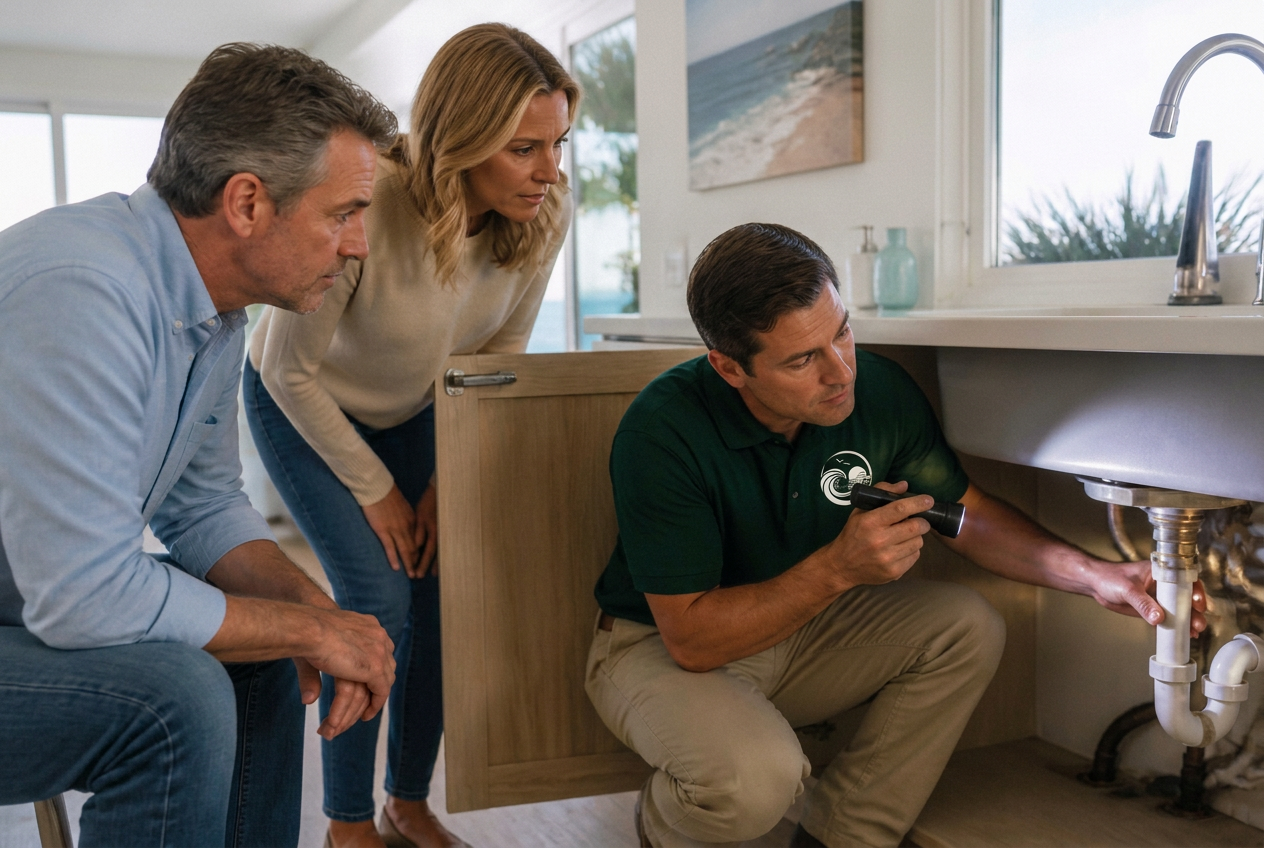
Homes in Manhattan Beach range from 1940s beach cottages to new construction on the same lot lines, and each era brings its own moisture story. Older houses have crawl spaces, single-pane windows and stucco that has weathered decades of salt air. Newer builds are tighter, which is efficient but unforgiving — when moisture gets in, it has fewer ways out.
A residential mold inspection accounts for that, and for the way a household uses the space: how long showers run, whether bathroom fans actually vent outside, whether the garage is now an office, how often windows open. Those details determine indoor humidity as much as the weather does.
What we inspect in a home
We work through the property systematically so nothing gets skipped because it was inconvenient to reach.
- Bathrooms — pans, grout, fan ducting, the wall and ceiling of the room below
- Kitchens and laundry — supply lines, drain connections, dishwasher pans, dryer venting
- Bedrooms and closets on exterior walls, where condensation and stagnant air combine
- Attics — sheathing, insulation contact, bath fan terminations, roof penetrations
- Crawl spaces — vapor barrier, standing water, subfloor and joist condition, ventilation
- Garages, converted spaces and additions where envelope details are often improvised
- HVAC equipment, filtration, condensate handling and accessible duct runs
- Windows, doors and the exterior envelope on the weather-exposed side of the house
Families, tenants and health concerns
Many calls come from a parent whose child's asthma worsened, or a tenant whose complaints have gone unanswered. We treat those situations carefully. We measure, document and date everything, and we write reports that a landlord, property manager or physician can read without needing us to translate.
We do not make medical claims and we do not tell anyone their home is dangerous. We report what is present, at what level, compared with what.
Condos, HOAs and shared walls
Condo work has an extra dimension: the source is often outside the unit. Water can enter through a common-area roof, a neighbor's plumbing, a shared stack or an exterior wall that the association maintains. Our reports separate what we observed inside the unit from what the evidence suggests is originating elsewhere, which is exactly the distinction an HOA board needs in order to act.
What happens after the inspection
You receive a report with photographs, moisture data, thermal images, laboratory results if samples were taken, and a recommended scope written clearly enough to send to remediation contractors for bids. Because we never perform removal, that scope is not an estimate for our own work — it is a neutral description of what the evidence supports. We stay available afterward to answer questions as you compare bids, and we can return for verification testing once the work is finished.
Working with a local Manhattan Beach inspector
We are a service area business. Our inspectors travel to your property in Manhattan Beach rather than receiving visitors at an office, and we keep our work inside this one city so we know its housing stock, its weather patterns and its building department expectations. You can read more about our inspectors and standards, browse related work such as Mold Inspection, Indoor Air Quality Testing and Real Estate Mold Inspection, or contact us to schedule. Common questions are answered on our homepage FAQ.